
I love to rifle through vintage knitting patterns and just came across some notes aimed at helping knitters improve their work.
The little gems of advice were included in a book of (Sirdar) knitting patterns that was given away free with a magazine. While no date is given with the booklet, I would say it was published in the 1960s.
Just a thought, the 1960s doesn’t seem that far away – we are looking at over 60 years ago, though! I don’t know about you, but that realisation made me feel quite old (I am in my fifties and still think it’s 1986 most days). I wish it was, at least.
Anyway, I have written out a summary of the hints and tips to better knitting and hope you will enjoy reading them. There are some knitting tips there that I have never thought of before. I do remember my grandmother covering her knees with a clean cloth. However, I am pretty sure she didn’t wash wool before re-using it from an unwound garment. I know I don’t bother to do that anyway. If I have to frog my work, I just start knitting with the unravelled yarn straight away.
I hope you enjoy these vintage hints and tips to better knitting. Please let us know if there are any knitting methods in the list that you did not use but will do in the future!
You can see below a photo of the booklet containing the knitting hints and tips summarised in this article.
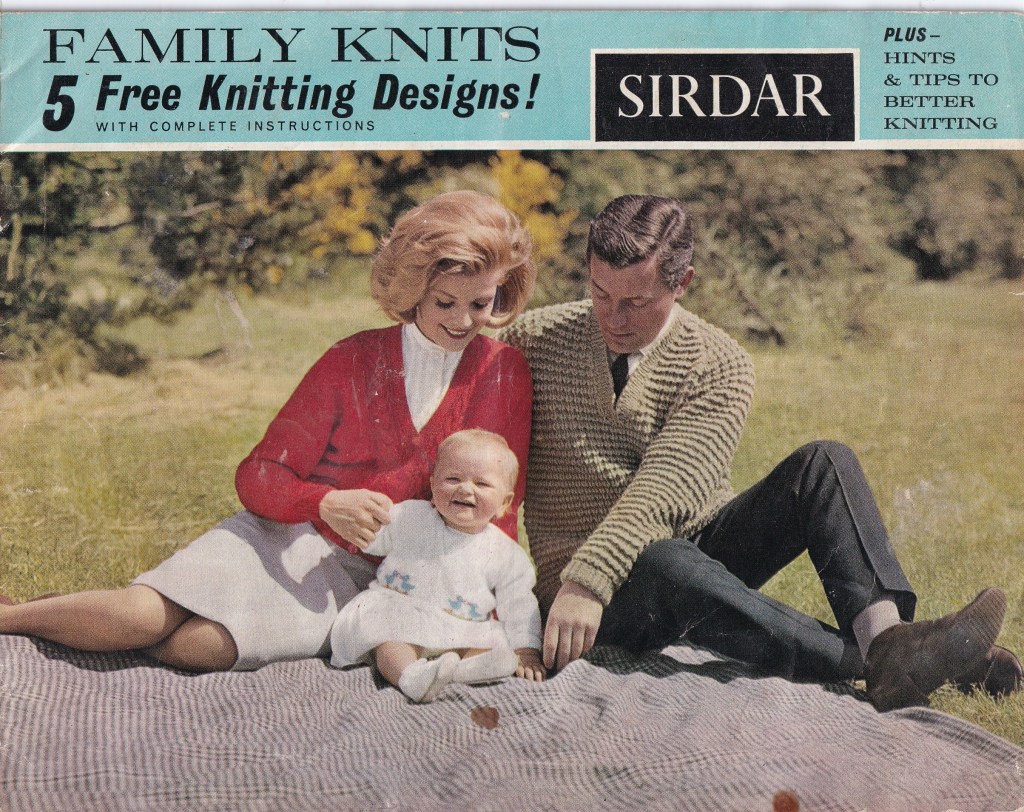
Some Vintage Hints and Tips to Better Knitting
Source: Family Knits Booklet by Sirdar circa 1960s (see above photo).
NEEDLES
Knitting Needles should be very smooth with well-graduated points, slightly blunted at the tip in order to avoid splitting the wool. Rigid needles are more likely to produce an even tension than pliable needles, but if made of metal they should have a cellulose or composition covering to prevent them from soiling the wool.
WOOL
This should be of the best quality that can be afforded – preferably a branded line, because the yardage is more reliable, and it is easier to match for further quantities. Even in branded qualities, the standard colour may vary slightly in different dyeings, therefore it is wiser to buy suffcient to cover your requirements at the beginning. When working from a published instruction always use the particular quality specified as it is possible for a similar quality produced by other spinners to differ considerably, and the finished result may be very disappointing. Choose a Sirdar quality and a Sirdar leaflet and be sure of success.
KNITTING INSTRUCTIONS
Knitting instructions published by a reputable firm will be found reliable and easy to work from if followed carefully — paying particular attention to punctuation. Sirdar leaflets are renowned for their simplicity and accuracy. You can follow them with ease to perfect results.
MEASURING
Measuring knitting should be done on the flat. When comparing two pieces count the rows on each piece, do not rely on measurement
ABBREVIATIONS
Publishers use various abbreviations to describe the same details so abbreviations should be checked before commencing.
RE-USING THE WOOL
Before re-using wool which has already been knitted, wind the wool into a loose hank and after tying in several places, wash gently and rinse in clear water. Wrap in a towel and squeeze out most of the moisture then hang up the hanks by one end until dry. Loosely re-wind into a ball in the usual way.
JOINING WOOL
A new ball should be joined in at the beginning of the row, leaving a loose end from this ball and the previous ball. When making up, tighten the end stitches to the correct tension and finish off by running the ends along the seam edge or if sufficient, use the loose ends for sewing up the seams.
WASHING HAND KNITTED GARMENTS
Do not allow the garments to get too dirty. Gentle and frequent washing in lukewarm, soapy water is the safest. Do not rub because this will cause the fabric to felt. Squeeze gently to remove the dirt. Do not lift the garment up by one end while the weight of the water is in it, this will stretch it. Rinse thoroughly in clean, tepid water until all trace of washing agent is removed. Quickly remove as much moisture as possible by rolling in a towel. Gently shape the garment to its original measurement and dry flat. If space for drying presents difficulties place the garment between sheets of clean paper and leave under the carpet.
CLEANLINESS
Wash your knitting needles before commencing light coloured work, or you may find soiled stripes across your work.
Keeping knitting clean will be greatly assisted by the use of a clean cloth over the knees when working, and also by wrapping the pieces in this covering when laying aside.

 The Knitting Times
Knitting a vintage blouse has been on my To-Knit list for a while now. Your tips are wonderful. Thank you!
LikeLike
Knitting a vintage blouse has been on my To-Knit list for a while now. Your tips are wonderful. Thank you!
LikeLike
Thanks so much for letting me know the tips are helpful good luck with knitting your vintage blouse 🙂
LikeLiked by 1 person