
Written by Maz at The Knitting Times.
The Knitting Times uses affiliate links.
I have literally just finished sewing on the buttons for the baby cardigan that you can see above. I made it for my new grandson using a vintage 1940s knitting pattern.
My daughter absolutely loves it and I have to say that I really like of it too. It was pretty awesome to knit. The vintage knitting pattern describes the cardigan as a “Kumfi-coat” which is economical to knit. And it was – I used up around 60g of yarn and I absolutely loved not having any sleeves to set in at the end.
However, the old knitting pattern had a few, what shall we say, niggles in it. The issues that I encountered whilst trying to read the vintage knitting pattern has inspired me to write this article. Perhaps it will help someone to knit a lovely retro baby cardigan such as the Kumfi-coat, or perhaps simply inspire you to try something different.
Anyway, please do read on to find out some tips about how to read and use vintage knitting patterns.
The best place to buy vintage knitting patterns
So you want to try to knit a wonderful vintage pattern, be it for knitting or crochet. If you are very lucky, you may find some in charity shops and thrift stores. However this can be very hit and miss. In my opinion, the best places to buy (and indeed sell) vintage knitting patterns are Etsy and Ebay.
Ebay is an awesome place to buy original vintage knitting patterns. The one that I used to knit the Kumfi-coat was from Ebay as part of a bundle. It is possible to buy huge job lots of old knitting patterns and I have come to discover that many of these become available via house clearances. If you are lucky, you can really grab a bargain, either by bidding and being lucky in auctions, or from spotting some awesome buy it now vintage patterns. Click here to view some of the vintage knitting patterns currently available on Ebay.
Etsy is different to Ebay, in that you can purchase instant download patterns which you then print off yourself. This is a lot more economical than Ebay, especially if you only want to knit one or two specific designs. There are dozens of shops specialising in instant download vintage knitting patterns on Etsy. I have compiled a little list here which I consider some of the best.
- Subversive Femme. An excellent source of vintage ladies knitting patterns. This Etsy store specialises in hard to find vintage knitting patterns, and in particular plus size designs.
- Dolly Rock Patterns. This is a lovely Etsy shop with hundreds of vintage knitting patterns for sale. If you like to like to knit baby clothes you will definitely enjoying browsing through this store.
- ECB Crafts. An Etsy shop which specialises in retro character type vintage knitting patterns. A wonderful selection to take you back in time to be found here.
Anyway, once you have your vintage knitting pattern in hand, you will soon see that times really have changed. Read on to find out exactly what that means, and to discover some top tips for knitting with vintage patterns.
Substituting Yarns
When knitting from a vintage pattern, you will more than likely have to substitute the yarn. This depends on the age on the pattern, but innovation within the yarn industry and changes in fashion means that may types of yarn are discontinued as time goes on.
The best place to start when substituting yarn is to look at the weights of the yarn in the pattern. Is it a double knit, a 4 ply, an aran? If you are not sure, look at the needles used in the vintage pattern. A 4mm needle usually indicates a double knitting yarn, for example. Of course, within each yarn weight, there can be a big difference between brands. Some have more meterage, are thicker, thinner, fluffier, and so on, Always buy an extra couple of balls for your vintage project so you don’t end up with a big sad face when you can’t finish your project.
I used a lovely self striping yarn for my latest vintage project. The knitting pattern is a Kumfi-Coat which is available as a PDF here on Etsy. I will not fib – I did not do a tension square. I could see however that I needed to use DK yarn and decided to go for Cygnet Yarns Baby Prints because I like it. Actually I am looking at the photo now and thinking that the cardigan looks wonky. I am hoping it is just my eyes :))))).

Some very old knitting patterns don’t tell you the weight of yarn required, but the meterage (length) needled to knit the piece. If you stumble across this issue, it is useful to know that patterns from the 1940s or before call for wool and yarn that was much heavier than what we are now familiar with. So when knitting very old designs it is likely that you will need less yarn than stated.
Something else that has changed about knitting patterns over the years is the size and fit of garments. Vintage sizes are considerably smaller than they are now. It is important to properly look at the pattern and make sure that your work will be wearable once completed. Perform a tension square before casting on, and check your measurements as you go along. This is especially important when increasing and decreasing within your work.
Fun vintage knitting facts
A modern day UK size 12 has a waist size of 30 inches. In the 1950s it was only 26 inches. For this reason, you may need to go up a size or two when knitting vintage patterns.
Vintage knitting patterns often use imperial measurements, both for yarn and for knitting needles. 4oz of yarn is approximately 112g or two to three 50g balls. If your pattern uses imperial knitting sizes, you will need to convert them to modern day sizes. Please see below for a chart that will help you with this.
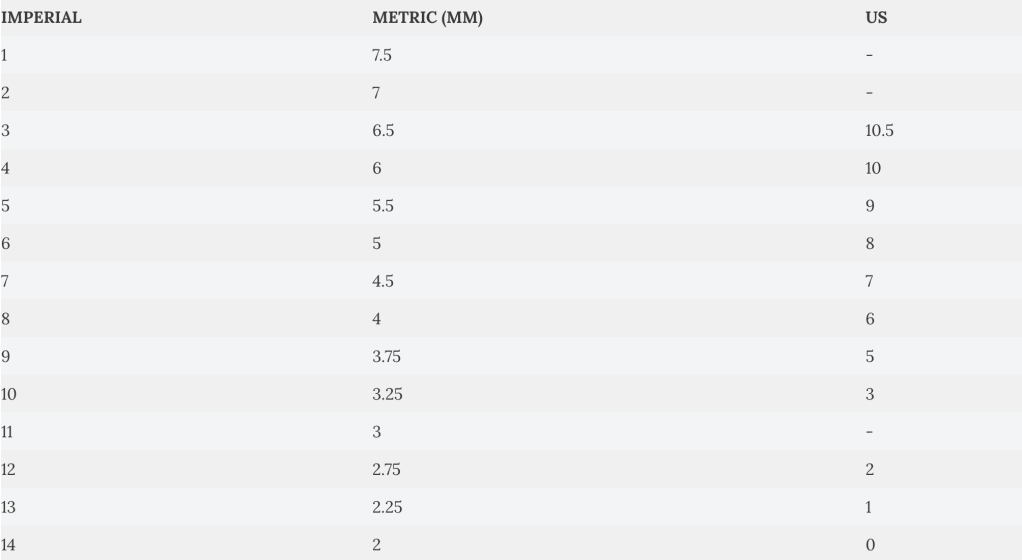
You may notice that some of the imperial knitting needle sizes don’t exist in USA equivalents. I would say, if you come across this issue when knitting a vintage pattern, go up or down a size, depending which way works best when you work a tension square.
Other issues when using a vintage knitting pattern
In my personal experience, vintage knitting patterns give far fewer actual instructions than modern ones. When I was knitting the Kumfi-coat, for example, I really had to think before each row. It seemed somewhat like jibberish actually and I really scratched and my head a lot. There were no comments such as 4 stitches remain on needle, or whatever, and I thought that it was clearly aimed at someone who did a lot of knitting. I am fairly experienced so I got there in the end, but it wasn’t easy.
For this reason, I would say that vintage knitting patterns are not an ideal start for beginner knitters. I think you would need to be able to find your way around a few types of modern patterns before tackling an old design. However, I am basing this purely on myself, my skills and my brain, which is middle aged and sometimes has fuzzy edges.
Someone else may well pick up the same pattern and breeze through it in a day. It took me a week to knit the Kumfi-coat because I was really quite confused at some of the instructions and went off and had far too many cups of tea.
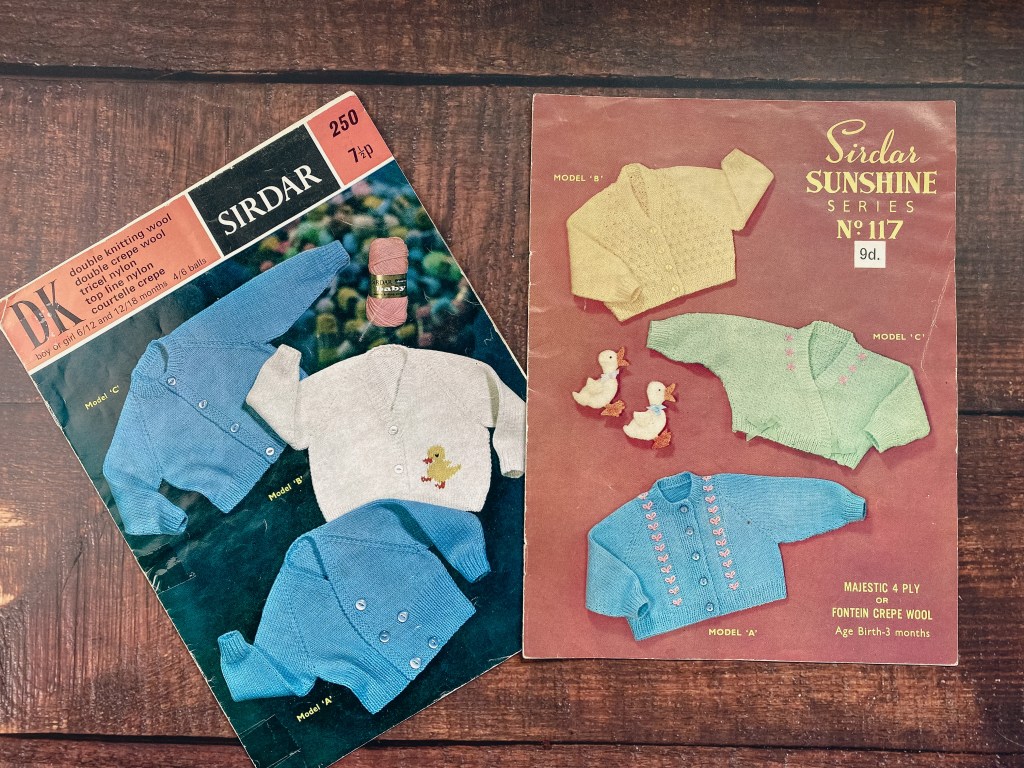
Anyway, please do try and give vintage knitting patterns a try. They enable us to wear such beautiful and unique, timeless pieces. I think the vintage baby knitting patterns in particular are stunning, and very much in vogue with the upcoming millennial parents and carers. Here you can see two more of my Ebay finds. Yay!
If you do take the plunge, good luck and I hope you enjoy vintage knitting a super great deal!

 The Knitting Times
Would love to know the pattern name for this wee cardy
LikeLike
Hello there, it is a Kumfi-coat by Hedge Nook Wools circa 1940s I believe 🙂
LikeLike
Love your little Kumfi-coat. Can you please share the pattern name and number. I know it’s an antique pattern – but I would love to try and hunt it out. Thank you.
LikeLike
Thanks so much, Kumfi-coat knitting pattern is leaflet 20 from Hedge Nook Wools. It is a wonderful knit apart from the vintage issues mentioned above 🙂
LikeLike
Would love a copy of this pattern please?
LikeLike
Hello there, I am just adding a link to the Kulfi-coat knitting pattern now, really should have done that before shouldn’t I 🙂
LikeLike
Thank you so much for adding the pattern!😊🌻
LikeLike
Hi ..would also love to apattern .?looked really cute …Yvonne sherriff …(76) year old newzealand ,,,thanks.
LikeLike
Hello there, a PDF file of the Kumfi-coat pattern is available on Etsy, I am adding the link to the article now.
LikeLike
I agree that vintage knitting patterns tend to assume a high degree of skill and experience. Not just in the knitting but also in the making up. I can do the knitting – been knitting for 60 years now, but I am sometimes not happy with the finished results after my sewing up doesn’t come out like the picture, particularly with some fiddly necklines. When I think of the needlecraft skills my nan had (born 1901) – those old ladies were well taught!
LikeLike
Yes I completely agree with you, my gran was the most amazing knitter. I don’t like sewing up and have found that some of the very vintage baby cardigan knitting patterns don’t have any – dolman sleeves for example. The patterns aren’t that easy to follow though.
LikeLike